Case Study · AI Product Design

Designing Hirello.ai's
Foundation

How Early UX Insights Shaped a Product Pivot

Role Lead Product Designer Duration 6 months Team Solo designer · 2 founders Platform Web App
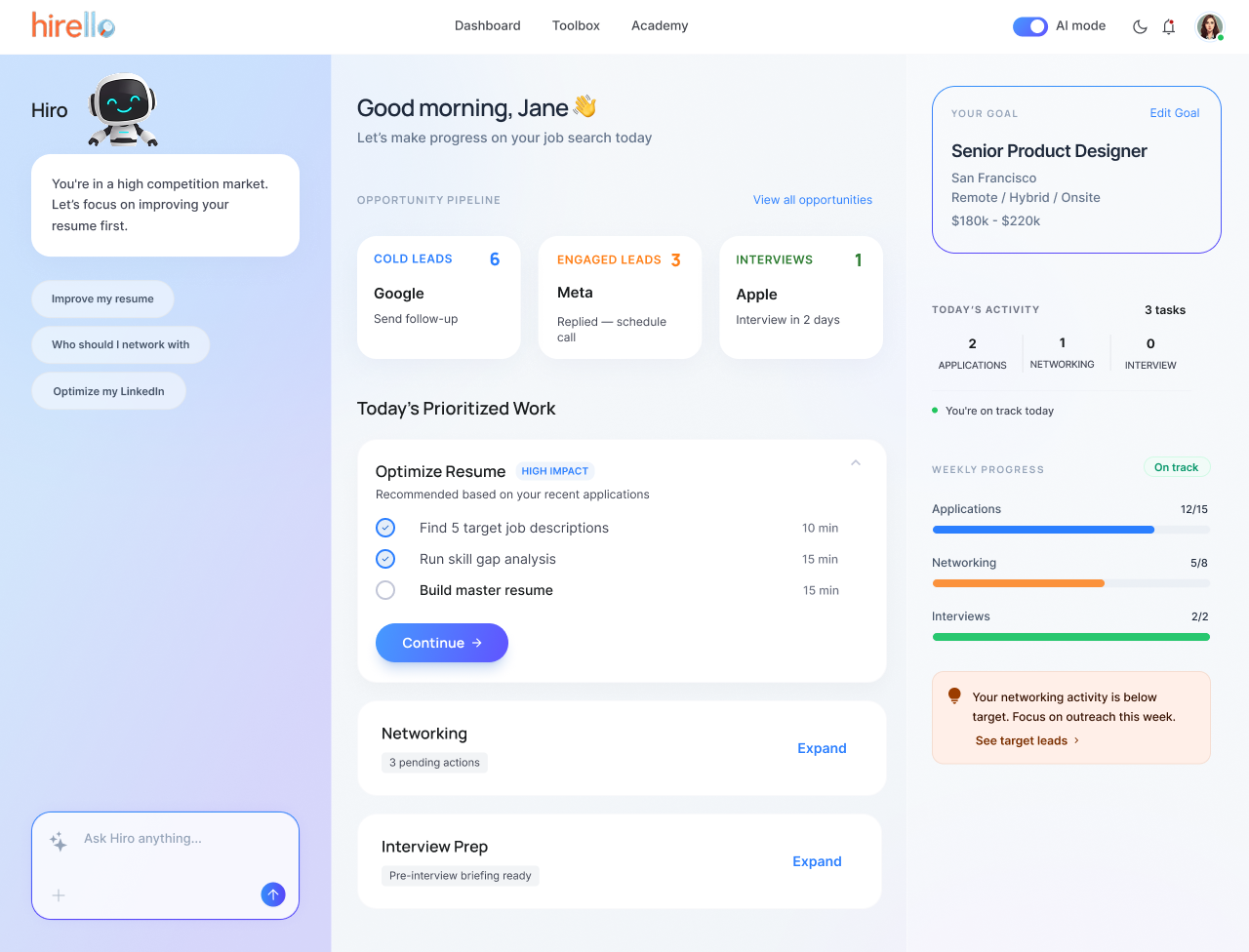
Hirello.ai dashboard

An ambitious vision,
a blank canvas.

Hirello.ai is an AI-driven career platform helping users navigate their job search intelligently. It combines guided workflows, data-driven insights, and a conversational AI assistant named Hiro to make career growth more efficient and human.

My Role

  • Designed the onboarding experience, dashboard, and opportunity pipeline interface.
  • Defined the early visual direction and UI framework for the product.
  • Collaborated directly with the founders to translate business strategy into intuitive UX.
  • Synthesized user research and interviews that led to the dashboard redesign and eventual product pivot.
Hirello.ai

When I joined Hirello.ai, the product existed only as an ambitious vision — an AI-powered copilot to guide users through their job search journey. As the founding Product Designer, I was responsible for transforming a 60-page vision document into tangible, intelligent interfaces.

No structure.
Just a big idea.

My starting point was a 60-page vision document — dense with backend architecture, model choices, and technical implementation detail. Almost none of it was directly translatable into UX. My job was to extract the product intent buried inside it, and turn that into something a real user could navigate.

There was also an early tension to resolve: the founders were drawn to gamification — quests, streaks, reward loops. I believed this was the wrong direction for users who were already anxious and under pressure in their job search. A platform meant to guide and reassure shouldn't feel like a game. That conversation needed to happen early.

The key question

"How do we make an AI career assistant feel like a trusted guide — not a tracker, and not a toy?"

Messy by design.

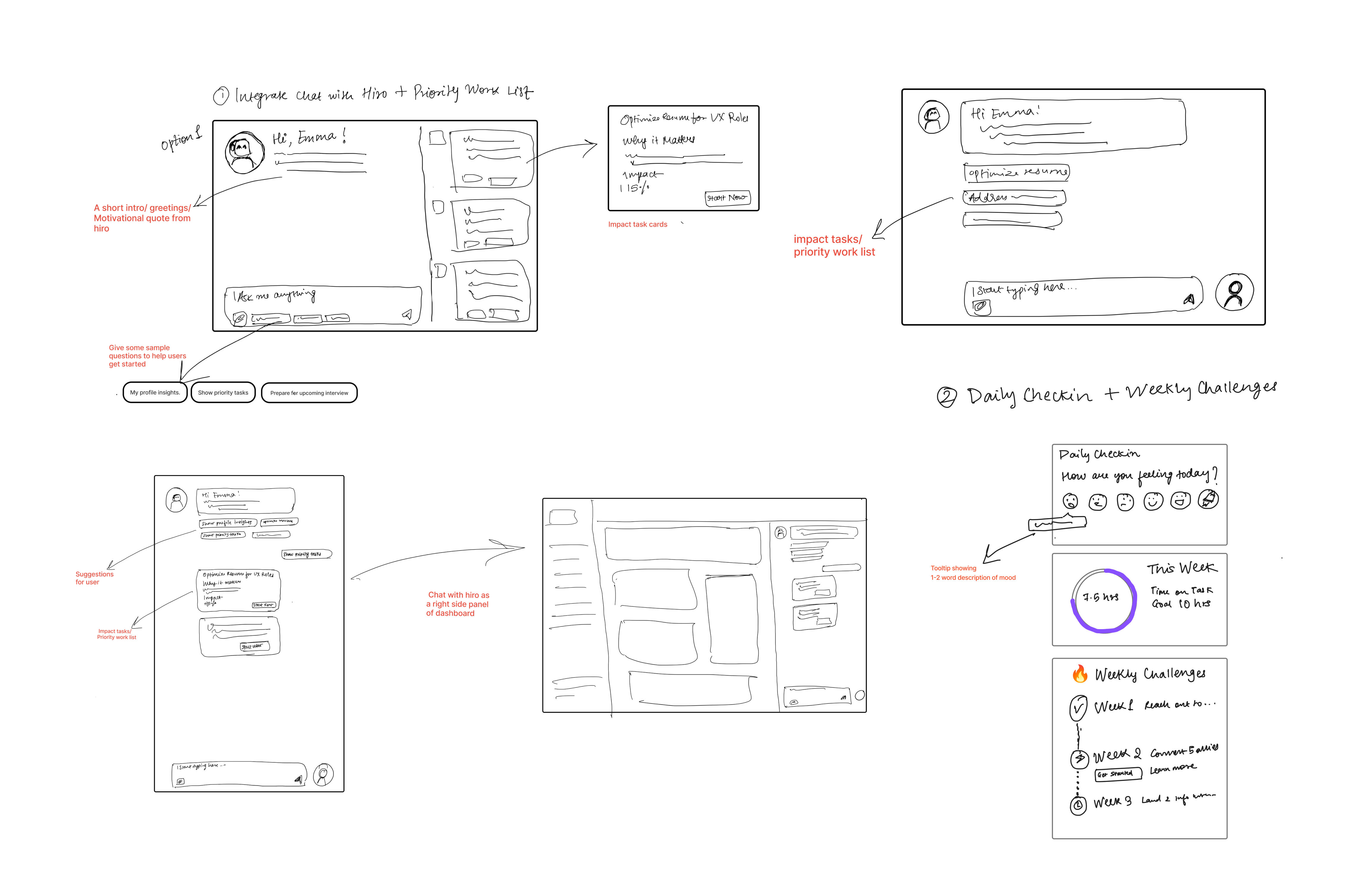
Before committing to the first dashboard direction, I sketched different ways Hiro, daily check-ins, and weekly challenges could come together on the screen. This captures that exploratory phase.

Early brainstorming sketches

The Vision

Goal: Create an AI-enabled workspace that organizes the job search.

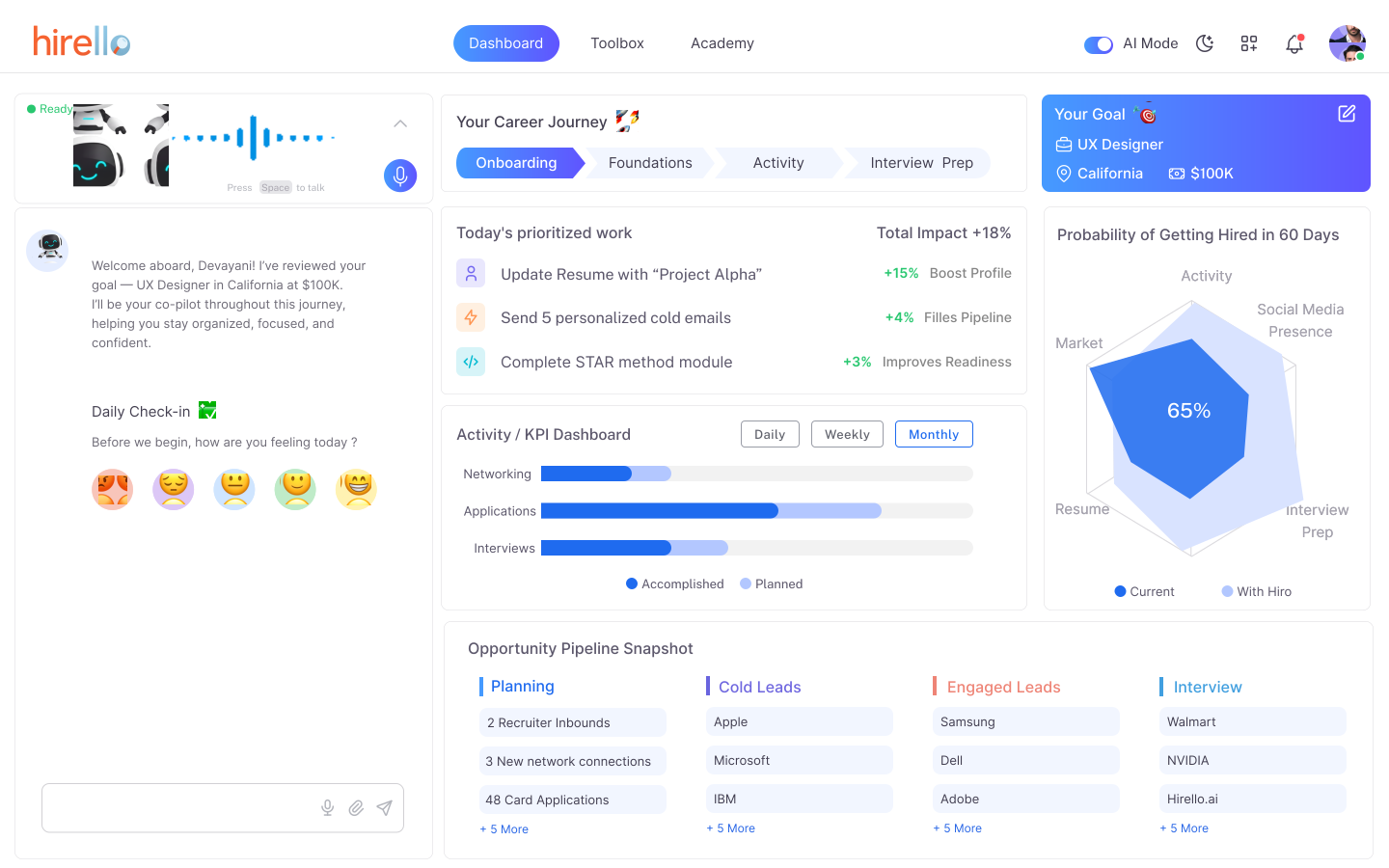
V1 was built around a hypothesis: if users could see their entire job search at a glance — pipeline, health score, tasks, and Hiro — they'd feel in control and know what to do next. The interface was designed to be comprehensive and visually clear, establishing the visual language and component system the team would build from.

Hiro AI Copilot

Your AI co-pilot guiding every step of the job-search journey

Prioritized Worklist

Surfaces the most impactful tasks so users always know what to do next

Hirello.ai Dashboard V1

Job-Search Health

Current progress vs. target across all dimensions — resume, activity, interviews

Opportunity Pipeline

Every lead tracked across stages — from planning to interviews

Over 4 weeks, we interviewed 10 users across different stages of their job search. The visual design landed — but the experience didn't. Users weren't engaging with the pipeline or health score. Almost universally, the one thing they kept coming back to was the worklist. Everything else felt like noise.

"It looks great, but I don't know what to do here."

User Interview

"It feels more like a report than a coach."

User Interview

Users didn't need more information — they needed clearer direction. The dashboard was showing them everything but guiding them nowhere.

From Vision
to Clarity

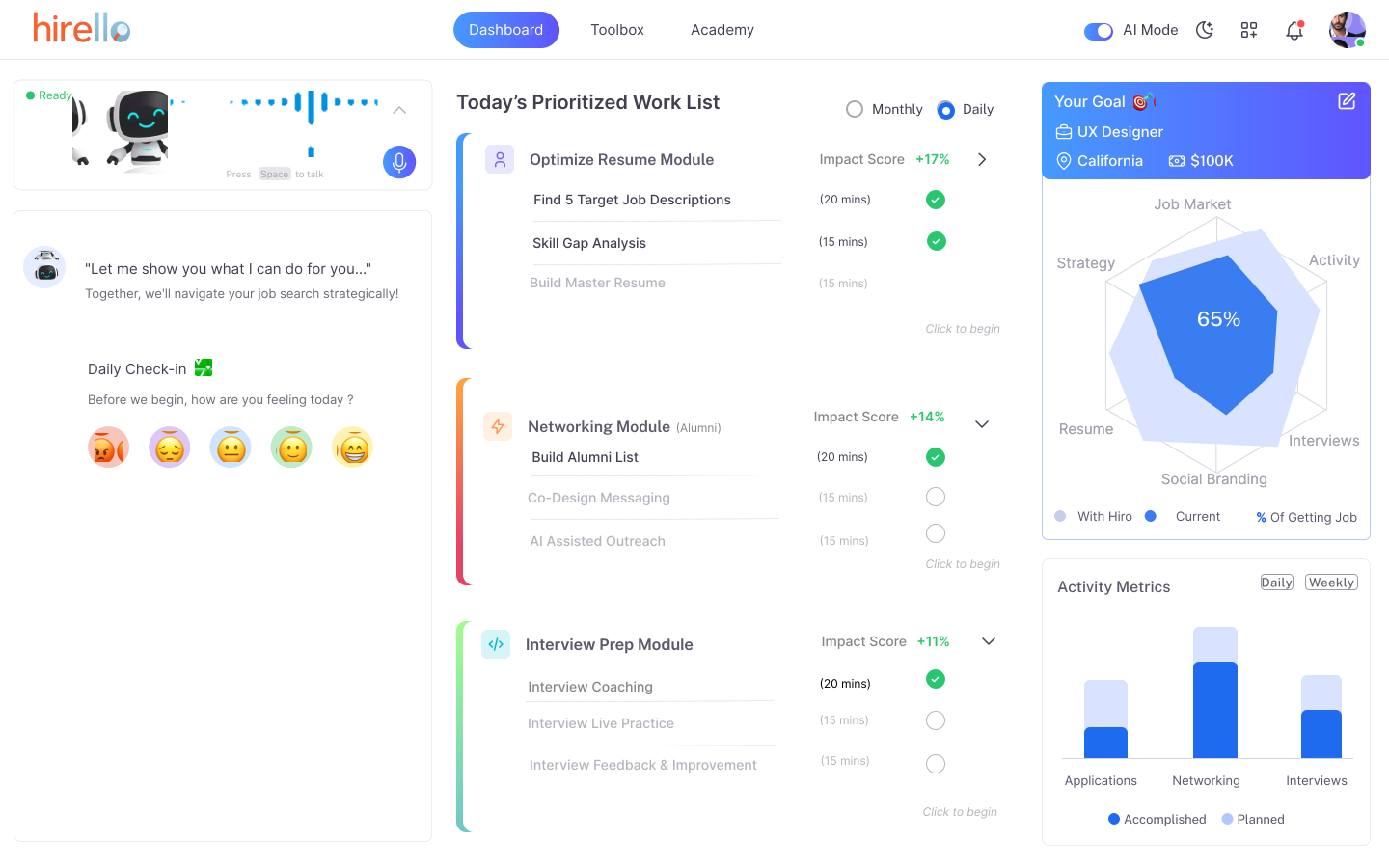
After speaking with users, we redesigned the dashboard to feel more guided, actionable, and less overwhelming. Users struggled with the Opportunity Pipeline — so we removed it and expanded the worklist into a structured daily plan. The key insight driving V2: users needed to know not just what to do, but why it mattered. Every task now shows an Impact Score — a percentage showing how much completing it moves the needle on getting hired.

Hirello.ai Dashboard V2

Impact-Scored Task System

The worklist became a structured daily plan across three color-coded modules — Resume, Networking, and Interview Prep. Each task shows an Impact Score so users understand exactly why they're doing it, not just what to do next.

🧹

Streamlined Layout

Removed the Opportunity Pipeline and health score widgets that users ignored. A quieter, more focused interface — Hiro and the daily plan take center stage, everything else steps back.

A Strategic Pivot

Across our 10 user interviews, a pattern kept surfacing that wasn't in the original product vision. Users weren't failing to track their applications — they were stuck because they didn't know the right people. The bottleneck wasn't organization. It was access.

I synthesized these findings and brought them to the founders directly. The data pointed to something bigger than a UI fix: Hirello's real opportunity wasn't job-search management — it was networking intelligence. I presented the case for a strategic shift, and the founders aligned.

From

Job-Search
Assistant

To

Networking
Intelligence

Visualizing Relationships

Refactoring the pipeline logic to track networking behaviors instead of just job applications.

🤖

AI-Powered Outreach

Leveraging Hiro to draft warm introductions and automate follow-up reminders.

💎

Measuring Trust

Moving beyond vanity metrics to measure relationship depth and connection strength.

This was the moment I understood what founding design really means — it's not just shipping screens. It's being close enough to users to see what the product should become before anyone else does, and having the conviction to make the case for it.

MVP Development

My research uncovered a critical business opportunity in networking, now the roadmap for Phase 2. To bridge the gap, we finalized Dashboard V2 as the foundational MVP.

Refining Micro-Interactions

Moving beyond static UI to define impact metrics and feedback animations.

Future Scalability

Ensuring the modular grid can adapt to the upcoming networking features.

Designing for Empathy

Creating motivation loops within AI-led experiences to prevent user burnout.

Meaningful outcomes
before launch.

The product is still in active development — but the design decisions made here have already shaped the company's direction, team alignment, and engineering execution.

Research → Strategy

Redirected the Roadmap

User interviews I led directly changed the product's strategic direction. The networking intelligence pivot — now Hirello's Phase 2 — came from patterns I identified and presented to the founders. That shift is now shaping the engineering roadmap.

Design Integrity

Held the Product Standard

Pushed back on gamification features and bright/playful visual directions that didn't match the emotional state of job seekers. The professional, calm aesthetic the product now has was an argued position — not a default.

Cross-Functional

Engineering-Ready Handoffs

Working directly with a team of 4 engineers, running design walkthroughs and maintaining a Figma file they build from. Reduced ambiguity in implementation by being the bridge between founder vision and technical execution.

0 → 1

Built the Foundation

Translated a 60-page technical vision document — with no UX structure — into a complete design system, component library, and two dashboard iterations that the engineering team is actively building from.

"The hardest part wasn't designing the product. It was knowing when to push back."

Working as a founding designer means navigating constant tension between founder enthusiasm and user reality. The gamification features, the color directions, the pipeline assumptions — these weren't bad ideas, they were just ideas that hadn't been tested yet. My job was to hold the bar, stay close to users, and make the case clearly. That's a different skill than just designing well.

"Advocate for the user, always."

Next Case Study

How I improved UMBC's study abroad
experience within system constraints.

View Project →